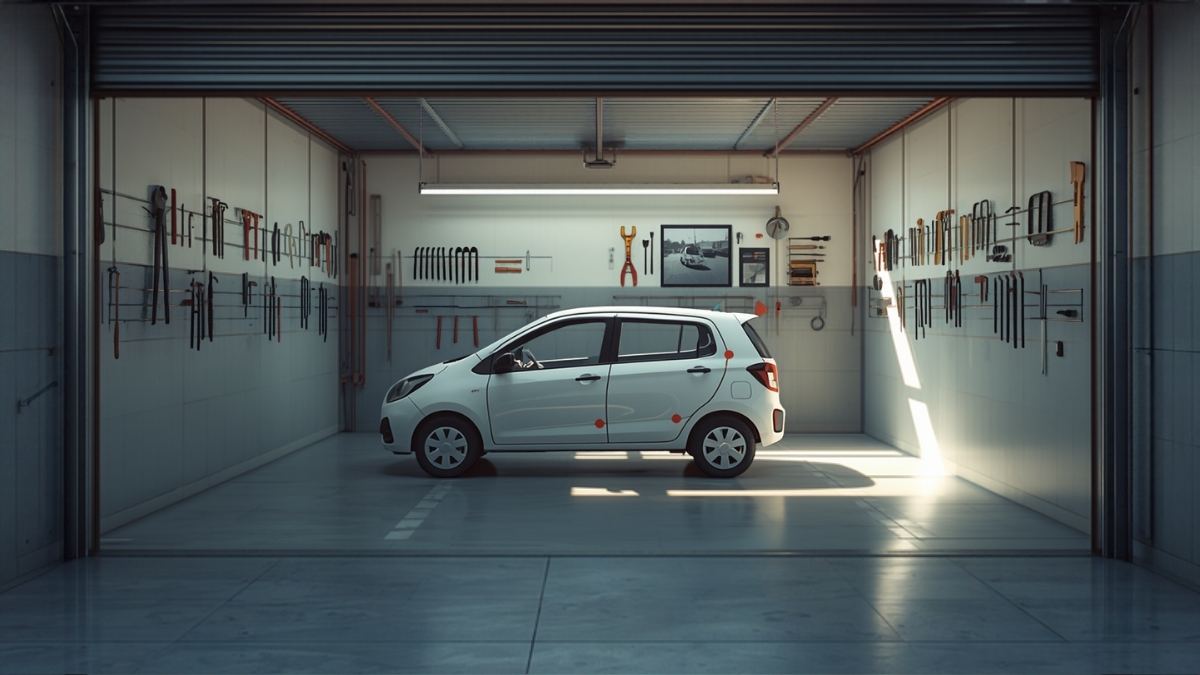

Home service is genuinely good for one kind of job and genuinely wrong for another, and most people booking a doorstep appointment never hear the difference explained. I have run our garage in Mylapore for 37 years, and every repair we do, denting included, happens inside our own workshop. We do not send a technician to your gate, not even for a dent that would be easy enough to fix there. This post explains why, and what to expect if you choose a doorstep provider instead.
What you will get from this: a clear line between the dent and paint work that travels well to your doorstep, and the work that genuinely needs a paint booth, so you can ask the right question before you book.
What can a doorstep mechanic actually fix well?
Paintless dent removal is the one job a competent doorstep provider can genuinely do well. It reshapes the metal from behind the panel using rods and tips, without cutting, filling or spraying anything. Since nothing wet needs to cure, dust and weather barely matter.
It suits shallow, rounded dents from a car door, a stray football or a parking bump, as long as the paint on top has not cracked, chipped or stretched. A skilled technician with the right tools can genuinely do this leaning against a compound wall, no lift required. At Yours Automobile this is also the most common repair we see: since 1992 we have painted and dent-repaired 5000+ cars, and a fair share started as exactly this kind of small, paintless dent, always in our own workshop.
Basic inspection also travels well, in the sense that it does not need a workshop. A technician can check a scratch, look at a panel gap, or give a rough estimate from a visual check, the same way we give you a rough figure from a WhatsApp photo before you bring the car in.
Why can't a car be painted properly outside your gate?
Because wet paint is defenceless for the first several minutes after it goes on, and a driveway or roadside has nothing to defend it with. Traffic dust, wind-blown grit, pollen, even a passing two-wheeler kicking up road dust can land in the clear coat before it sets, and once it is in there, it stays.
A single dust particle on a glossy panel shows up as a small bump the moment light hits it at an angle. Multiple particles across a door or bonnet mean the whole panel has to be sanded back and resprayed, which turns a same-day job into a repeat visit. This is not a rare risk outdoors. It is closer to the default outcome.
In Chennai specifically, the problem compounds. Between construction dust in growing neighbourhoods, exhaust particulate on main roads, and the humidity that keeps paint tacky for longer, an open-air spray job has more to go wrong here than it would in a drier, quieter city.
What does a paint booth actually control that open air can't?
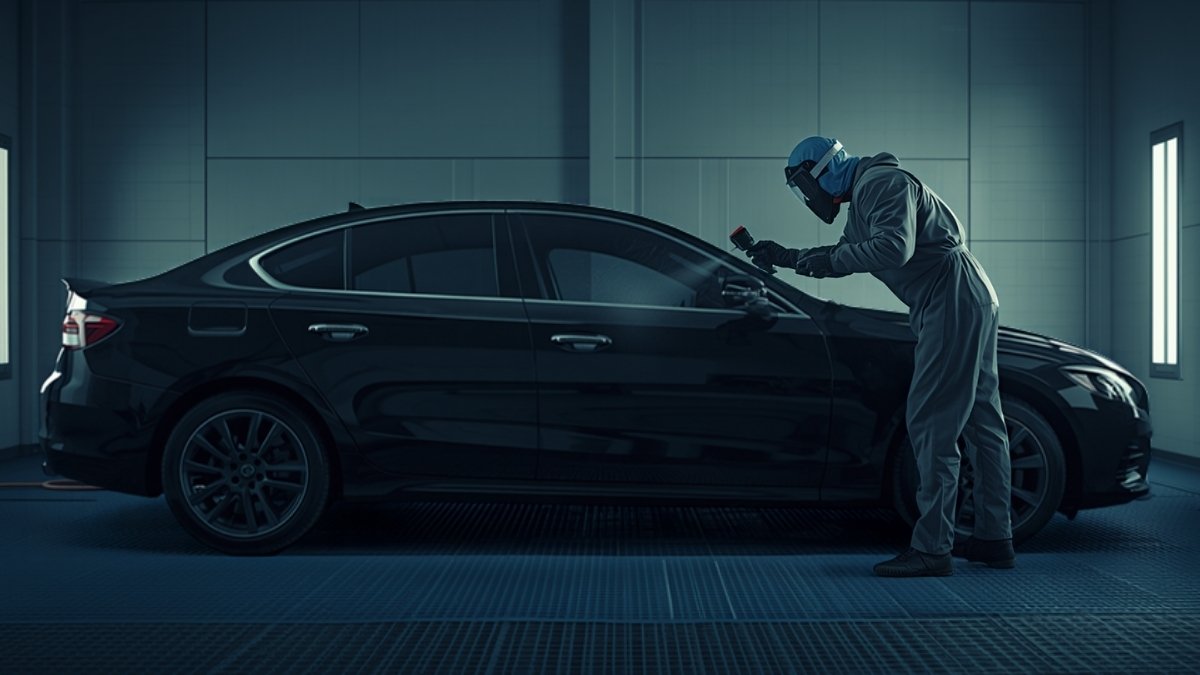
A proper paint booth is not just a closed room. It filters the air coming in, pressurises it slightly so dust from outside cannot leak through a gap, and controls temperature so the paint cures at the rate it was designed for.
Filtered, pressurised air
Positive pressure inside a booth means air pushes outward through any small gap, not inward. Outside contaminants cannot get pulled in the way they can into an unsealed space. This single feature is the biggest reason our own paint booth exists, and it is also the hardest thing to replicate at a customer's home.
Steady temperature and cure time
Paint and clear coat are formulated to cure within a specific temperature range. Spray it in the cool of early morning and it cures slowly and softly. Spray it in Chennai's midday heat and it can skin over too fast on the surface while staying soft underneath, trapping solvent that weakens the finish over time. A booth holds a steady range so the cure is predictable, panel after panel.
The part most people miss: a paint job that looks perfect on the day it is done can still fail six months later if it was cured in the wrong conditions. The damage from a bad cure rarely shows up immediately.
Can a home-service painter blend a repaired panel into the next one?
Rarely, and not to the standard we hold ourselves to. Factory-match paint on paper is only the starting point. The colour code gets you close, but sun fade, the angle of light and the exact mix on your specific car all shift how a fresh coat reads next to the older paint around it.
At Yours Automobile, we blend into the next panel when the colour calls for it, feathering the new coat outward so the transition disappears rather than stopping hard at a panel edge. That takes a controlled spray pattern, even lighting to judge the result as you go, and the ability to walk around the car and check it from every angle before it cures. A driveway with one bright patch of sun and one patch of shade makes that judgement call nearly impossible.
We have written more on this exact decision in our guide to full car repaint vs panel repaint, which covers when blending is enough and when the job needs to go wider.
What happens to masking and trim when painting happens outside a booth?
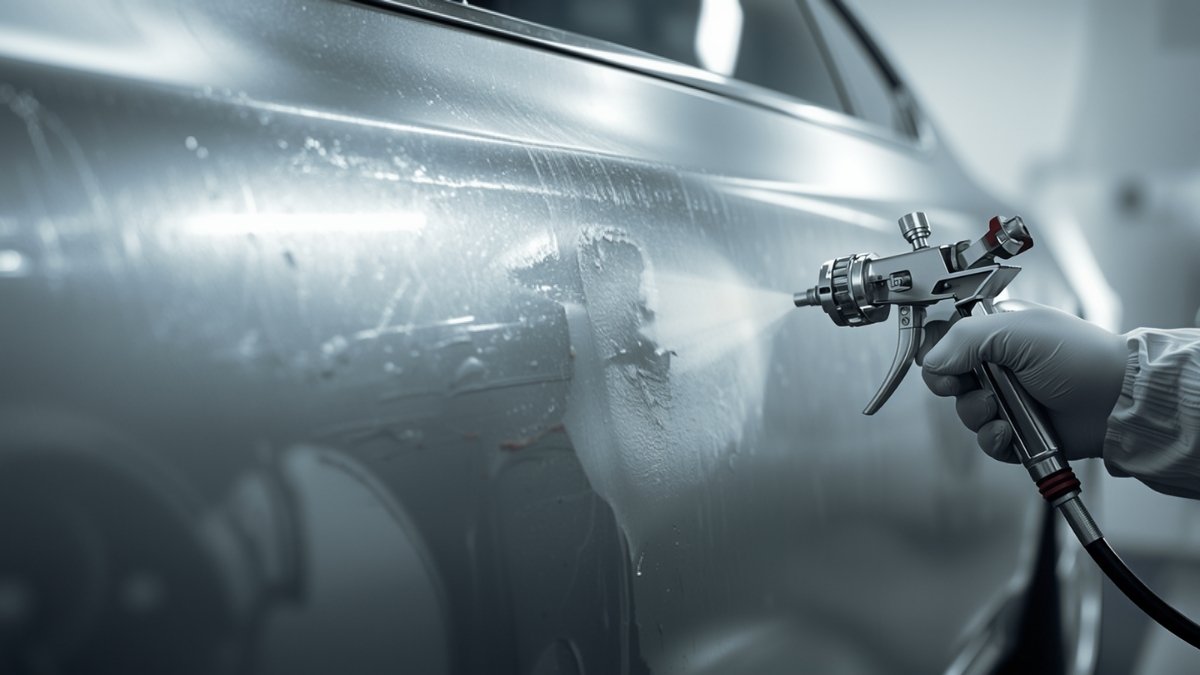
Every panel next to the one being painted needs to be masked off carefully; glass, rubber trim, badges, door handles, tyres. Overspray drifts further than people expect, and outdoors, wind carries it even further, sometimes onto a neighbour's parked car or your own gate.
Inside a booth, the airflow is designed to pull overspray down and away through the filtration system, so masking has a controlled boundary to work within. Outside, a light breeze can carry a fine mist of paint metres past your masking tape, and there is no way to contain it once it leaves the gun.
Is doorstep paintless dent removal safe for every dent?
No, and this is the check worth doing before you book. Paintless repair works on shallow, rounded dents where the paint is intact. It does not work on:
- Creased dents, where the metal has folded sharply rather than dished evenly.
- Dents on a body line or panel edge, where there is not enough flat metal to work the dent from behind.
- Any dent where the paint has cracked, chipped or scraped, since that area needs paint regardless of how the metal is shaped.
- Dents with stretched metal, common in harder, deeper hits, which need filler and paint to finish smooth.
If your dent falls into any of these, the honest answer is that the job will need paint at some stage, and that part belongs in a booth. You can read what typically drives the price of that kind of repair in our post on what decides car denting and painting cost in Chennai.
What about safety and ventilation for spray equipment outside a booth?
Automotive paint and clear coat give off solvent vapour as they cure, and a booth is built with extraction fans to clear that vapour away from the technician and away from anyone nearby. Spraying in an open driveway removes the fume risk to bystanders but adds a different problem: there is no controlled extraction, so the technician is working without the ventilation design that keeps the job safe and consistent. It is not a setup either of us should want for a job that is meant to last years on your car.
How do you know if your job needs paint or just denting?
Two checks, the same ones we use when a customer sends us photos on WhatsApp before booking anything:
- Run a finger over the dent. If it is smooth with no crack or chip in the paint, paintless repair is worth trying first.
- Look along the panel at a low angle toward a light. A crease, a sharp edge, or a dent sitting right on a body line usually means filler and paint will be needed, not just reshaping.
We covered the scratch side of this same question in detail in does a car scratch need repainting, which walks through the fingernail test for judging scratch depth the same way.
What should you ask a home-service mechanic before booking?
Three questions save most of the disappointment we hear about secondhand:
- "Is any part of this job going to need paint?" If the answer is yes, ask where that part of the work will actually be done.
- "Will you show me the dent and the paint condition before you start?" A technician who is honest about scope will point out anything paintless repair cannot fully fix.
- "What happens if the dent turns out worse than expected once you start?" Good technicians pause and talk to you rather than push ahead and hope it works out.
At Yours Automobile, we tell the customer about blending and any paint work before we do it, because it changes the time and the plan. Your okay first, on both the scope and the estimate, is how every job should start, wherever you take the car.
When does it make sense to skip home service and go to a garage with a booth?
Once paint is genuinely needed, whether that is a full panel respray, a colour blend, or a scratch down to primer, the booth stops being a nice-to-have and becomes the difference between a repair that lasts and one you pay to fix twice. That is also why we bring every car into our own workshop from the start, even for the paintless dents that would be fine at your gate. It is one visit, one place, and nothing gets missed because it was checked in a driveway instead of under proper light.
Across 3000+ happy customers and 150+ repeat customers, the pattern we see again and again is simple: people who ask what actually needs paint before they book tend to end up happier with the result, wherever they take the car.
Doorstep service vs paint booth: what each one is actually good for
This is the general pattern for any doorstep provider, not just ours to offer. We do not run a doorstep service ourselves, for the reasons in the next section, but it helps to know where the honest line sits before you book with anyone.
| Job | Doorstep / home service | Needs a paint booth |
|---|---|---|
| Shallow, rounded dent, paint intact | Yes, paintless dent removal works well | No |
| Visual inspection and estimate | Yes | No |
| Creased dent or dent on a body line | Limited, metal work only | Yes, for the paint finish |
| Scratch through the clear coat or colour | No | Yes |
| Full panel respray or colour blend | No | Yes |
| Stone chip touch-up (very small) | Workable, with care | Preferred for a clean finish |
| Rust repair after a deep scratch | No | Yes |
Why we don't offer any doorstep work, not even for dents
It would be easy for us to send a technician out for the straightforward paintless dents and keep only the paint work in our own booth. Several garages in Chennai do exactly that split. We choose not to, for a simple reason: you often cannot tell whether a dent is truly paint-free until you look at it closely under even light, and a dent that looks clean in a driveway can turn out to have a hairline crack in the clear coat once it is under our inspection lamp. On a doorstep visit, that leaves the technician to either guess and hope, or send the car back for a second trip anyway.
Bringing every car in from the start avoids that guesswork. One visit, one inspection under proper light, and a written estimate that already accounts for whether paint is needed, before any work begins. That is the trade we have made for 37 years, and it is why customers keep coming back with the next dent instead of a repair that had to be redone.
Frequently asked questions
Does paintless dent removal actually work?
Yes, for the right dent. Paintless dent removal massages the metal back into shape from behind the panel without breaking the paint. It works well on shallow, rounded dents where the paint has not cracked or stretched. It does not work on creased dents, dents at a panel edge, or any dent where the paint itself is damaged, since those need paint to finish properly.
Is doorstep car painting a bad idea?
It depends what is being painted. A very small touch-up on a stone chip can be done carefully outside. A full panel respray outside a booth almost always picks up some dust in the wet paint and cures unevenly, so the finish rarely matches the rest of the car under direct sunlight.
How is paintless dent repair done?
A technician reaches the back of the panel, often through the door cavity or by removing a trim piece, and uses metal rods and tips to gently push the dent back to its original shape. It relies on skill and patience rather than heat or paint, which is why a competent doorstep provider can do it reasonably well, even though we only do this work in our own workshop.
Can a home-service mechanic match my car's paint colour?
Getting the base colour code right is the easy part. Getting it to actually look right on the car needs blending into the next panel and spraying in even, controlled coats, which is difficult to do consistently in a driveway. At Yours Automobile we blend into the neighbouring panel when the colour calls for it, something that is hard to pull off outside a booth.
Why does dust matter so much during painting?
Wet clear coat is sticky for the first several minutes after spraying. Any dust, pollen or grit that lands on it in that window is sealed into the finish permanently. Indoors in a filtered booth, that risk is controlled. Outdoors on a Chennai street, with traffic dust and wind, it is not.
How do I know if my dent needs paint or just paintless repair?
Run a finger over the dent. If the paint is smooth, unbroken and the metal has not creased, paintless repair is often enough. If you see a crack, a chip, scraped paint, or the dent sits right on a body line or edge, the panel will need paint after the metal is shaped, and that part of the job should move to a booth.
Will a doorstep paint job look different later?
It can. Paint cured without steady temperature and humidity control often stays slightly softer than paint cured in a proper booth, which can show up months later as a duller patch or paint that marks more easily than the rest of the car when it is washed or polished.
Not sure what your car needs: WhatsApp a photo of the damage to +91 99419 51161. We will tell you honestly what the repair involves, then you bring the car to us and we handle the rest in one visit. Read more about our denting service and car painting service, or see hours and directions to visit us in Mylapore.